
How to Drill China to Make a Teacup Lamp
As an Amazon Associate, I earn from qualifying purchases.
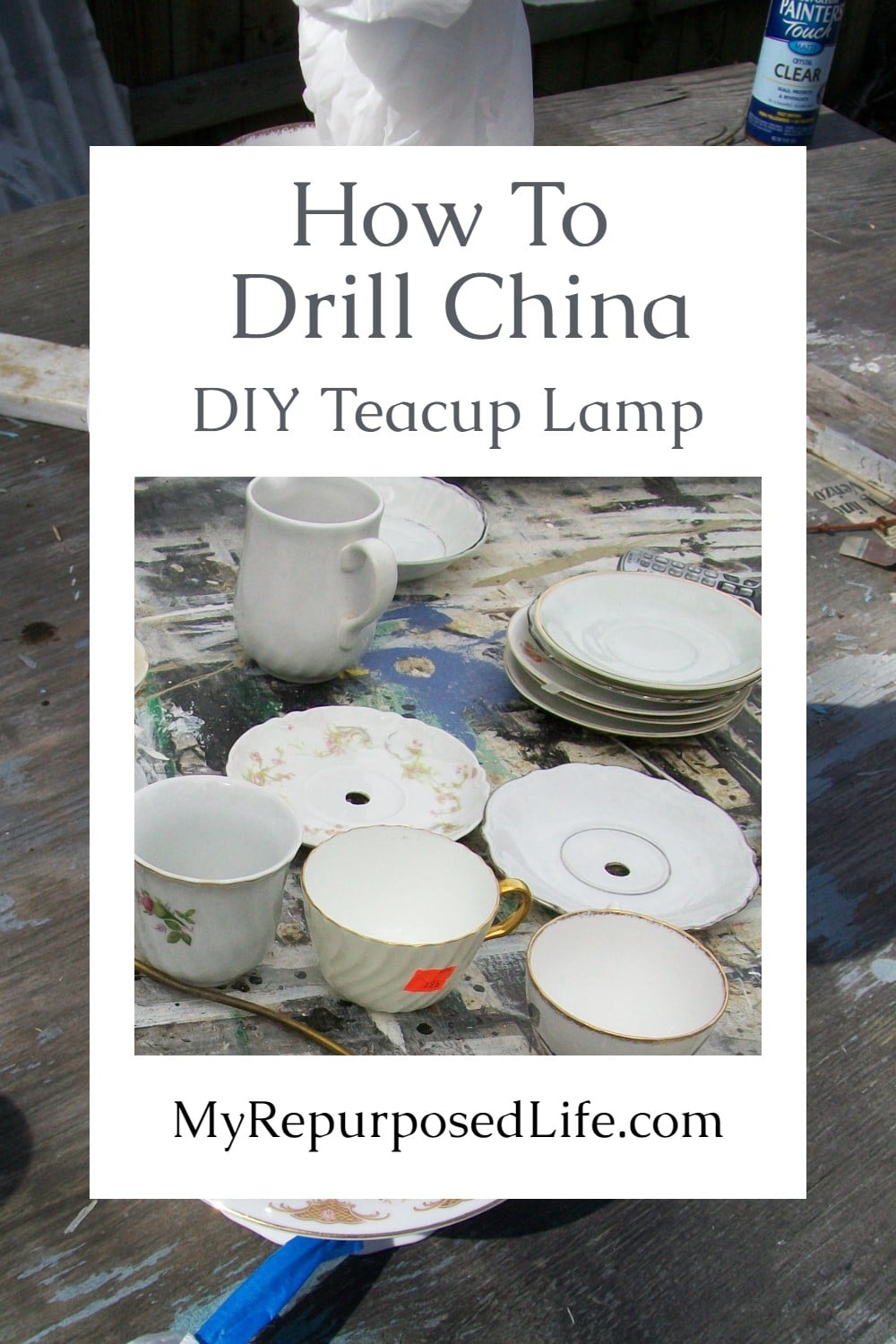
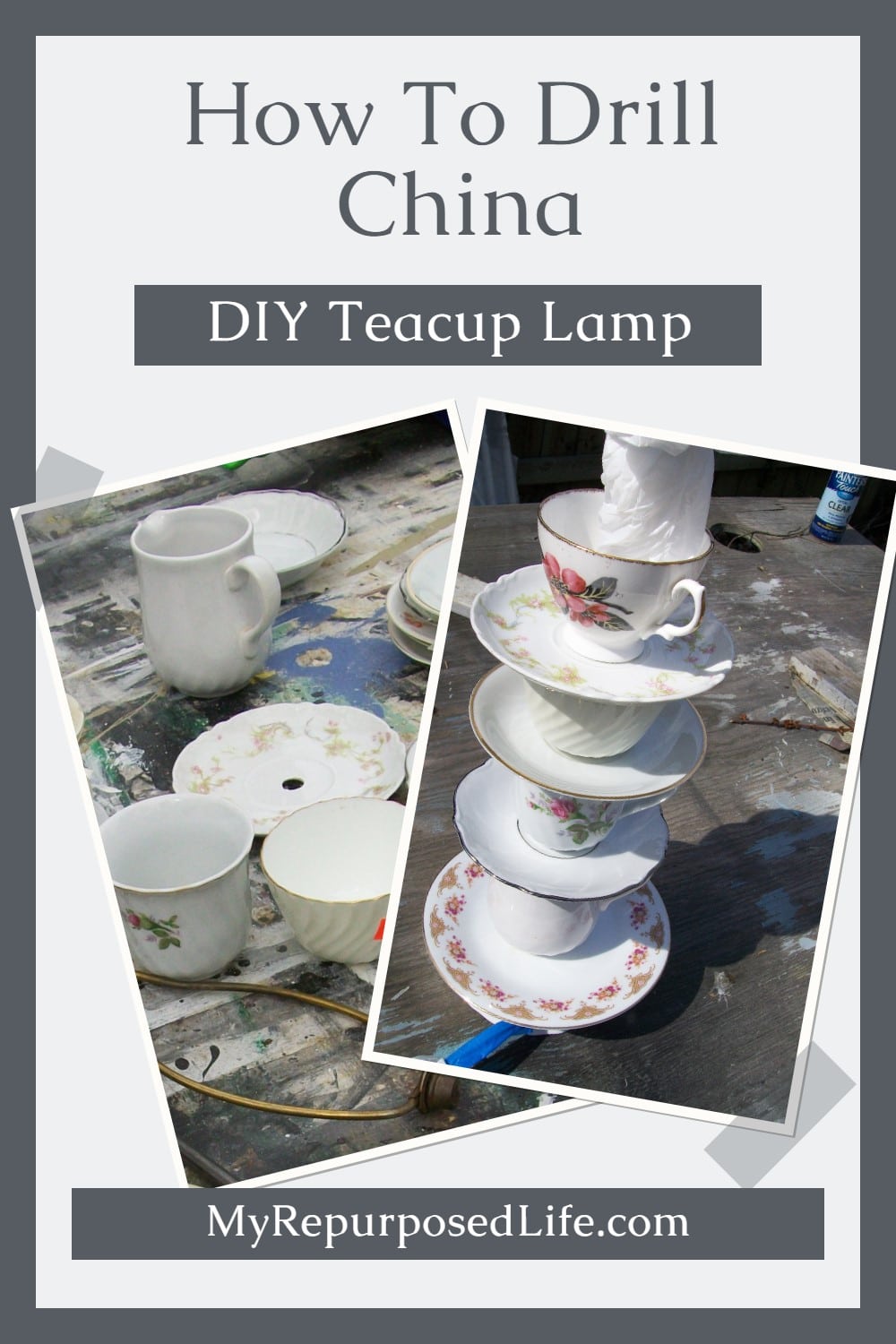
Delicate vintage teacups and saucers can easily be transformed into charming custom lamps. By carefully drilling holes through the center of each piece, these once-forgotten treasures become the perfect base for creating one-of-a-kind lighting. It’s a simple way to give old china a new purpose while adding a touch of timeless beauty to any space.
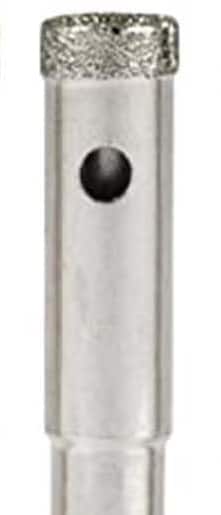
I used this type of Diamond Bit. I found it at Home Depot, but you can also find it on Amazon.
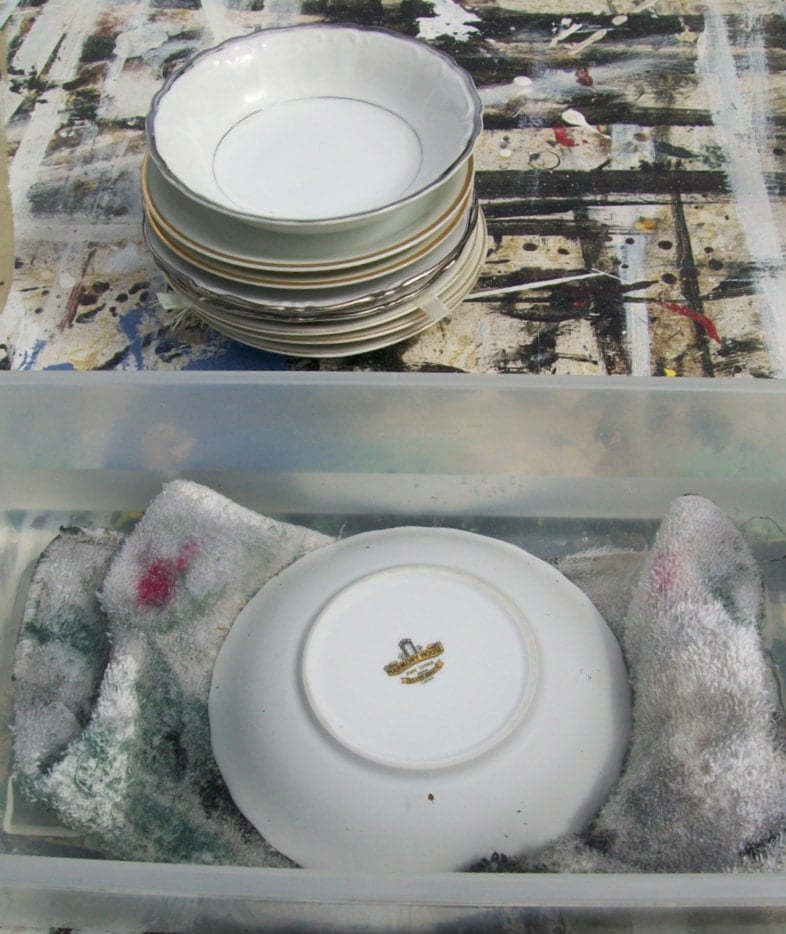
This was my first attempt at drilling glass. You can see other projects I’ve made at the end of this article.
Items Needed For Drilling China
- Thrift store china, like saucers and teacups
- Old towel
- Water
- Plastic tub
- Diamond Drill Bit
- Heavy Duty Drill
How To Drill China
Add a rag and water to the bottom of a plastic tub.
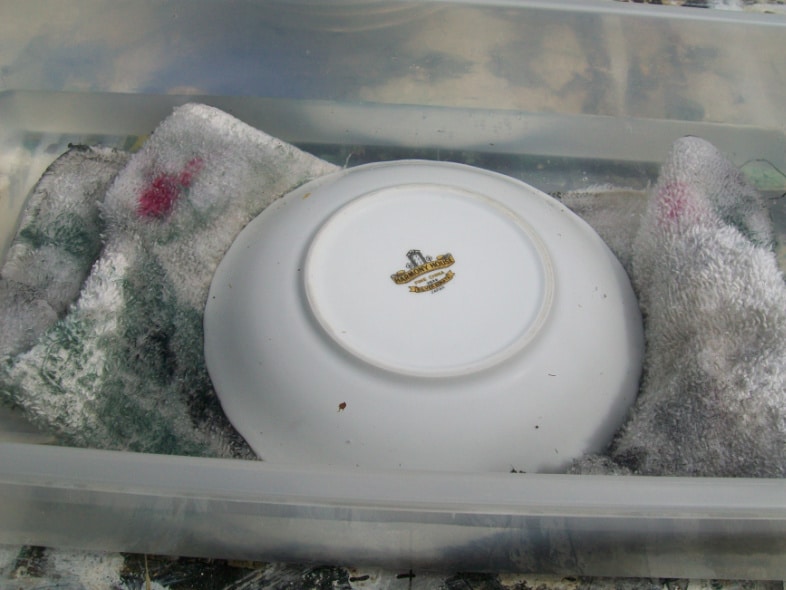
I placed my bowl in a container of water on an old rag to keep it from turning as I drilled. You just need enough water to cover the area where you’re drilling.
Use a Diamond Drill Bit on China
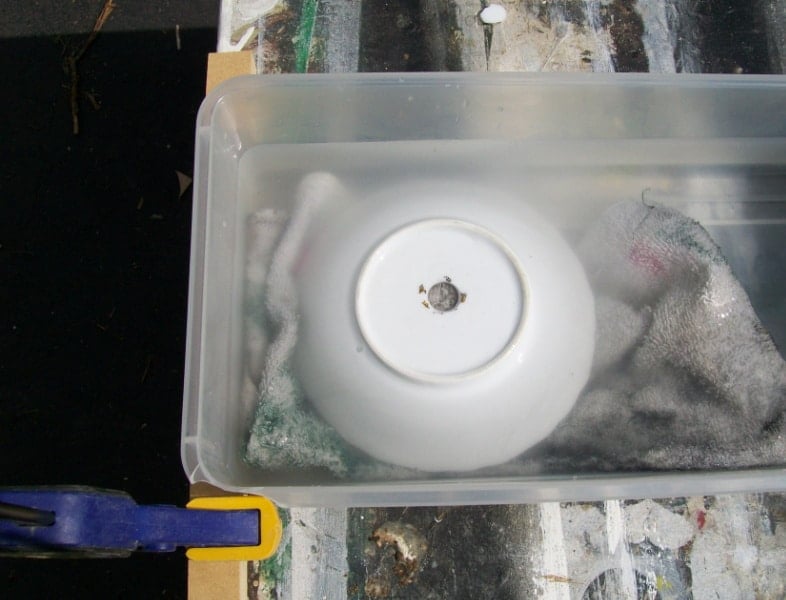
The water is necessary to keep the china cool while the diamond bit slowly does its job.
Drill slowly, keeping the china cool with the water.
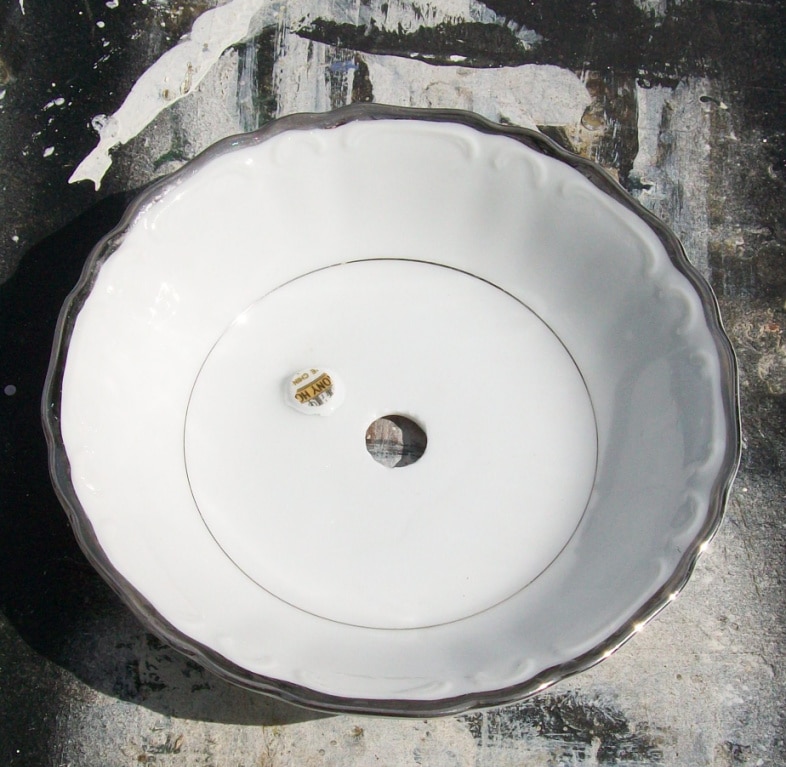
Isn’t it cute? Getting the hole right in the middle of a round object is a little tricky. Sometimes I use a large washer to help identify the center of a saucer or bowl.
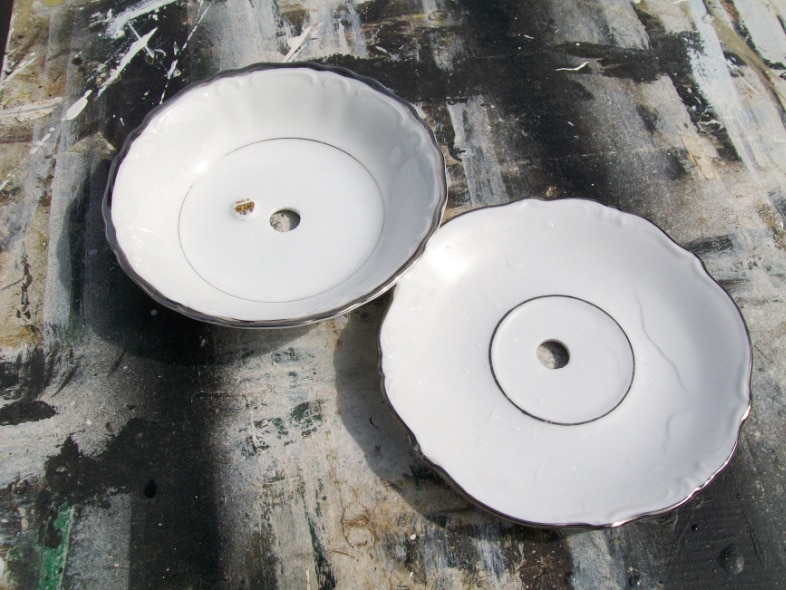
Patience is the key to this project; slow and steady wins the race.
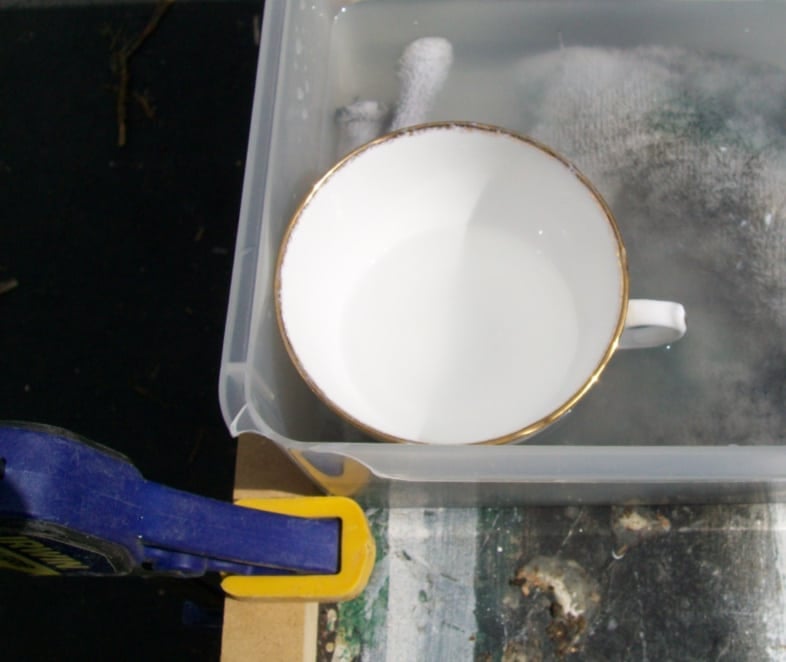
The clamp is holding a piece of scrap wood because the tub wants to “walk” across the table due to the vibration from the drill.
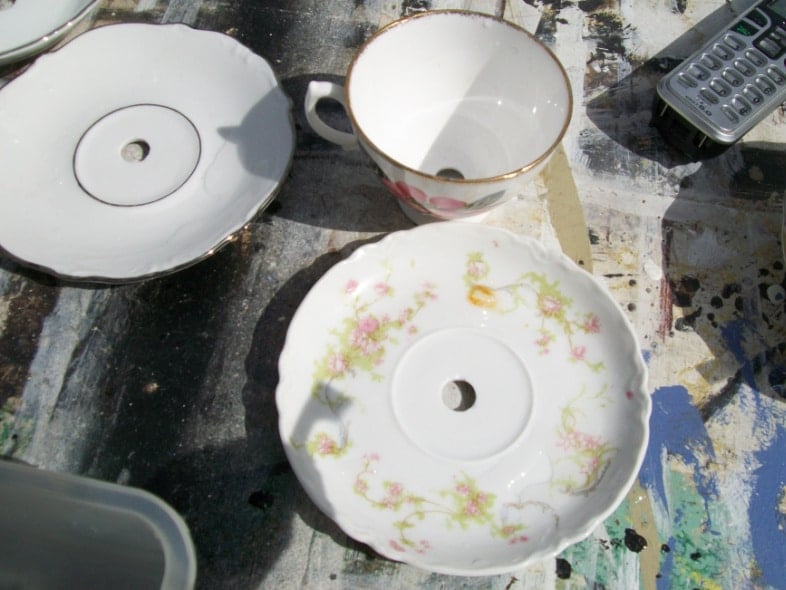
I recommend drilling more pieces than you think you’ll need so that you can experiment with the design of your lamp.
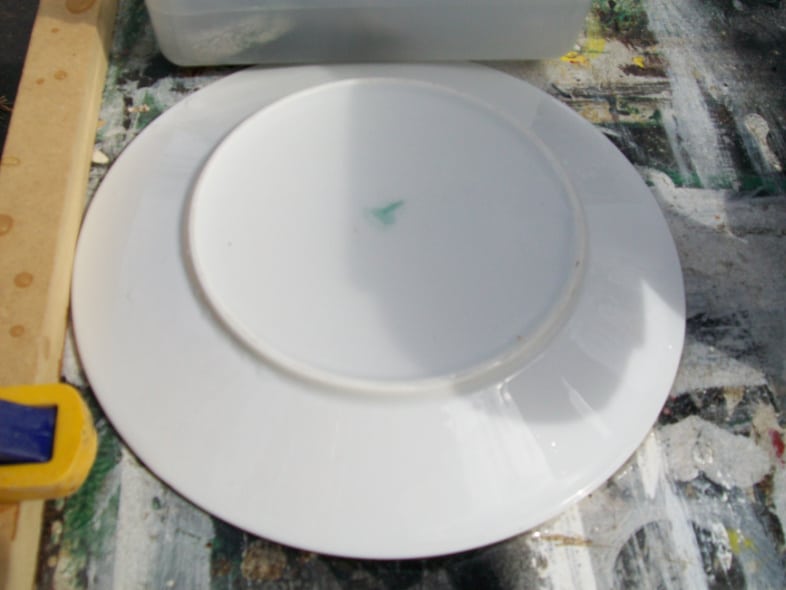
This plate was too large to fit in the tub, but no problem. Almost all the dishes I have cut have rims that naturally pool the water needed for cooling.
Do NOT try to drill glass or china without cooling it with water.
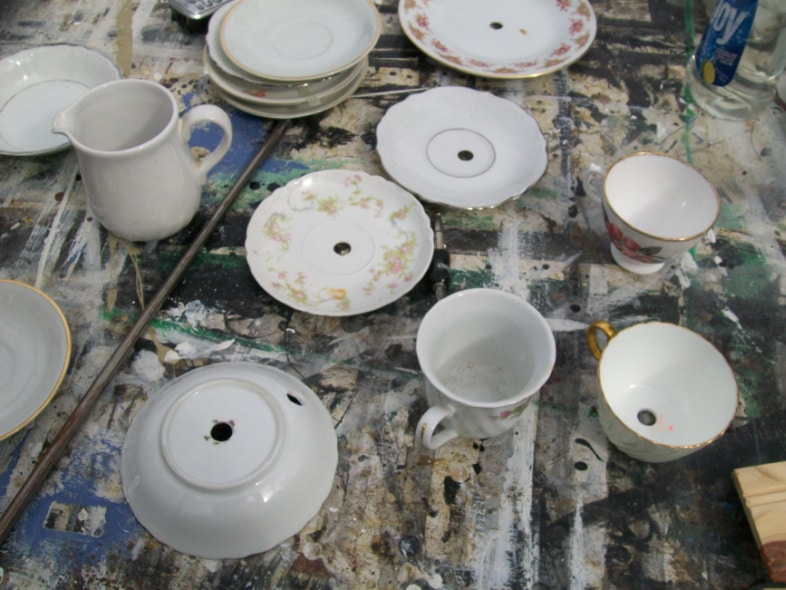
I cut all these pieces without breaking a single one!
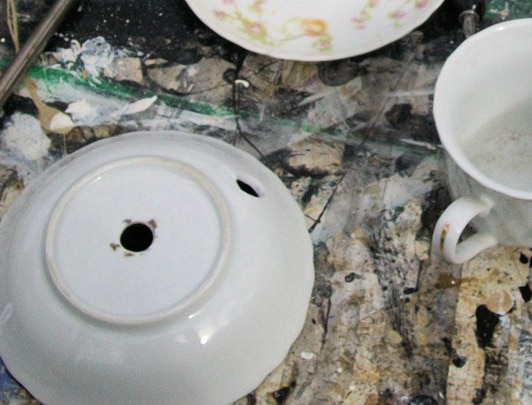
I used this small bowl for the “base” of my lamp. The base needs to have an extra hole for your cord.
How to Assemble a Teacup Lamp
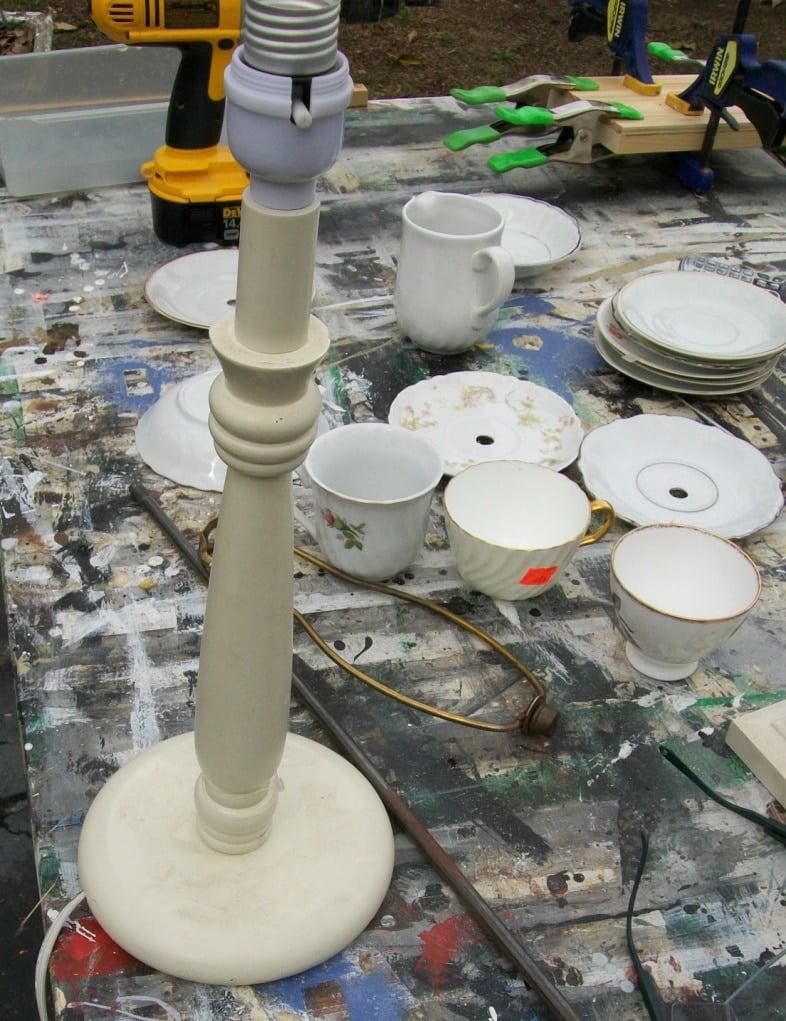
I used the guts of this thrift store lamp for my new teacup lamp. You can purchase a lamp kit to obtain the rod, but a thrift store lamp is often a more cost-effective option. Better yet, perhaps you have an old lamp you no longer need.
A kit will have washers and fittings, but if you’re upcycling an old lamp, save every piece you remove from it.
The length of your center rod will determine the height of your teacup lamp.
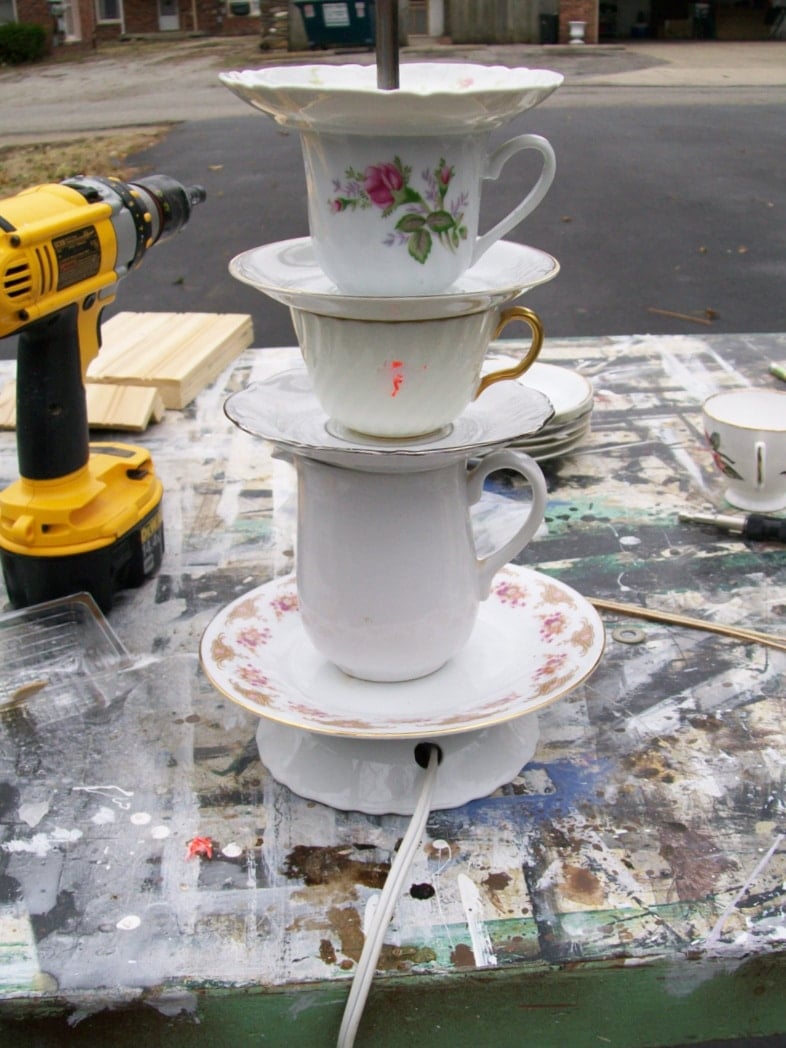
This is a dry fit to see how everything “stacks up”. You will see in the final images that I ended up adding one more teacup and saucer to the mix.
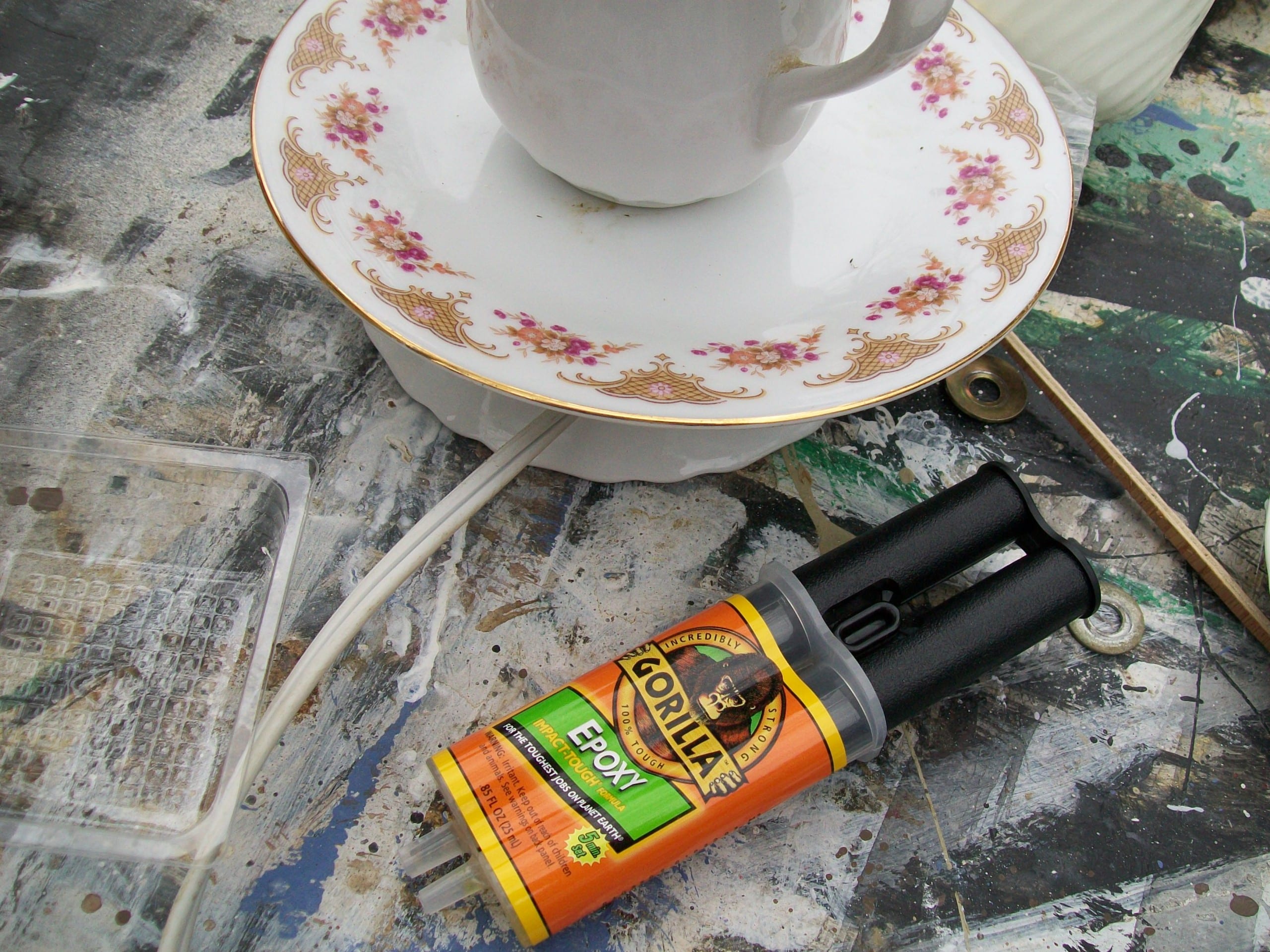
After stacking the pieces to match the height of my salvaged lamp parts, I connected the glass pieces with Gorilla Glue Epoxy. You may prefer E6000, or some other permanent adhesive. I share more details about threading the rod, washers, and nuts in my article, “Teapot Lamps.”
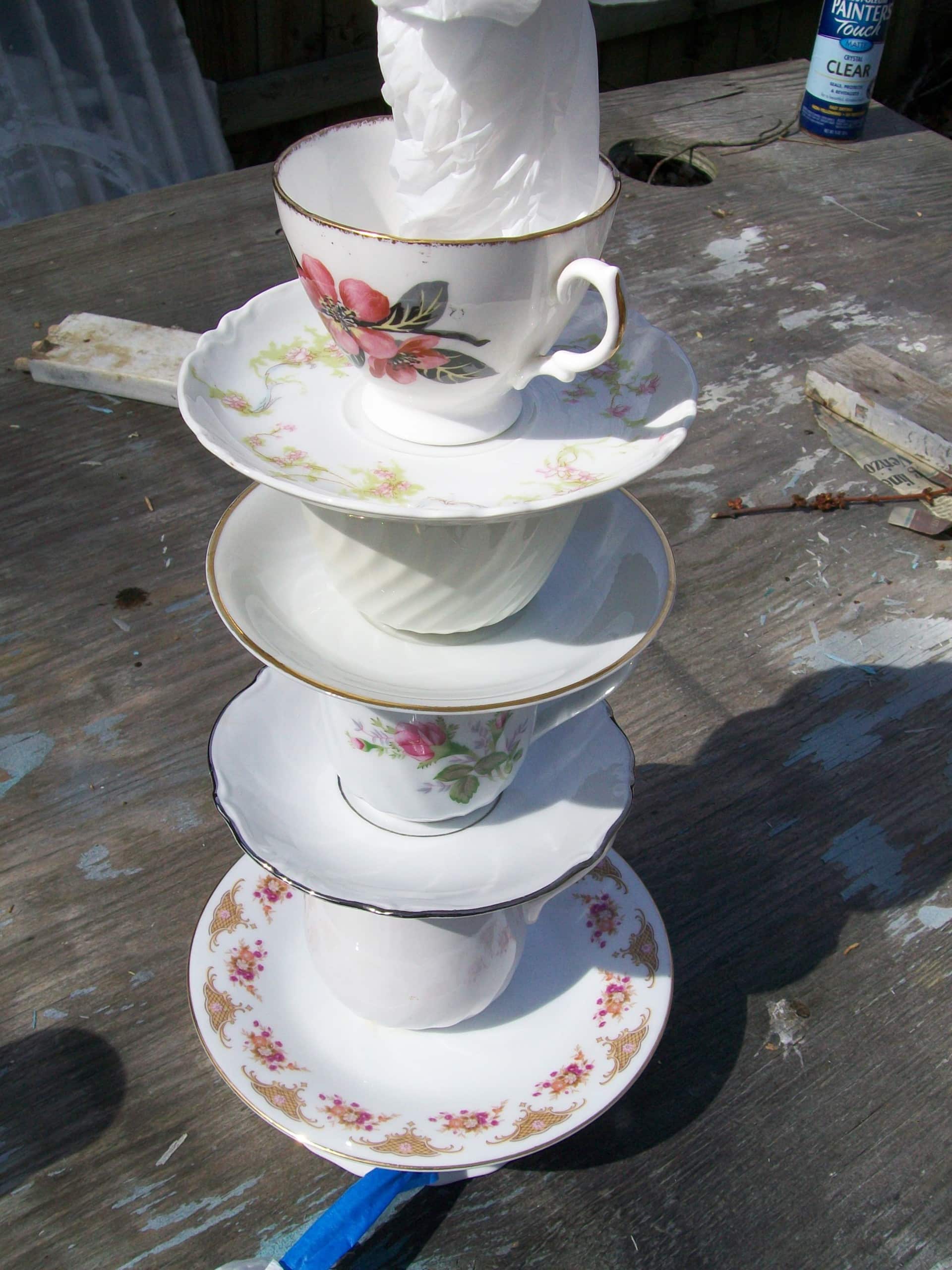
I didn’t intend to paint my pieces, but I used my least favorite pieces as my guinea pigs because I expected to break a bunch of cups and saucers. Because I didn’t like the variation of the patterns, I decided to paint the tower of teacups and saucers white.
Related Content: Spray Painting Glassware
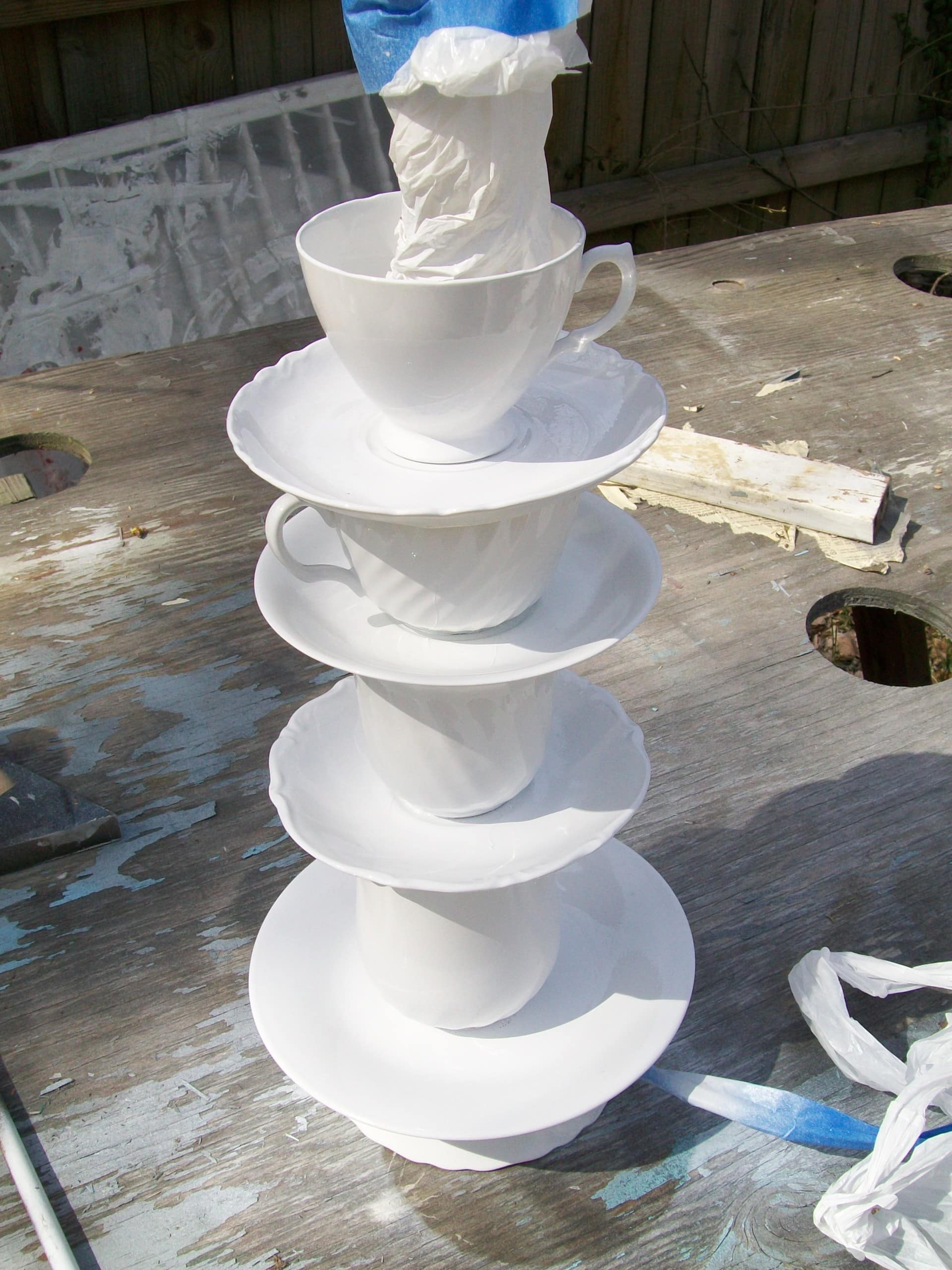
I really think I like the simplicity of the white.
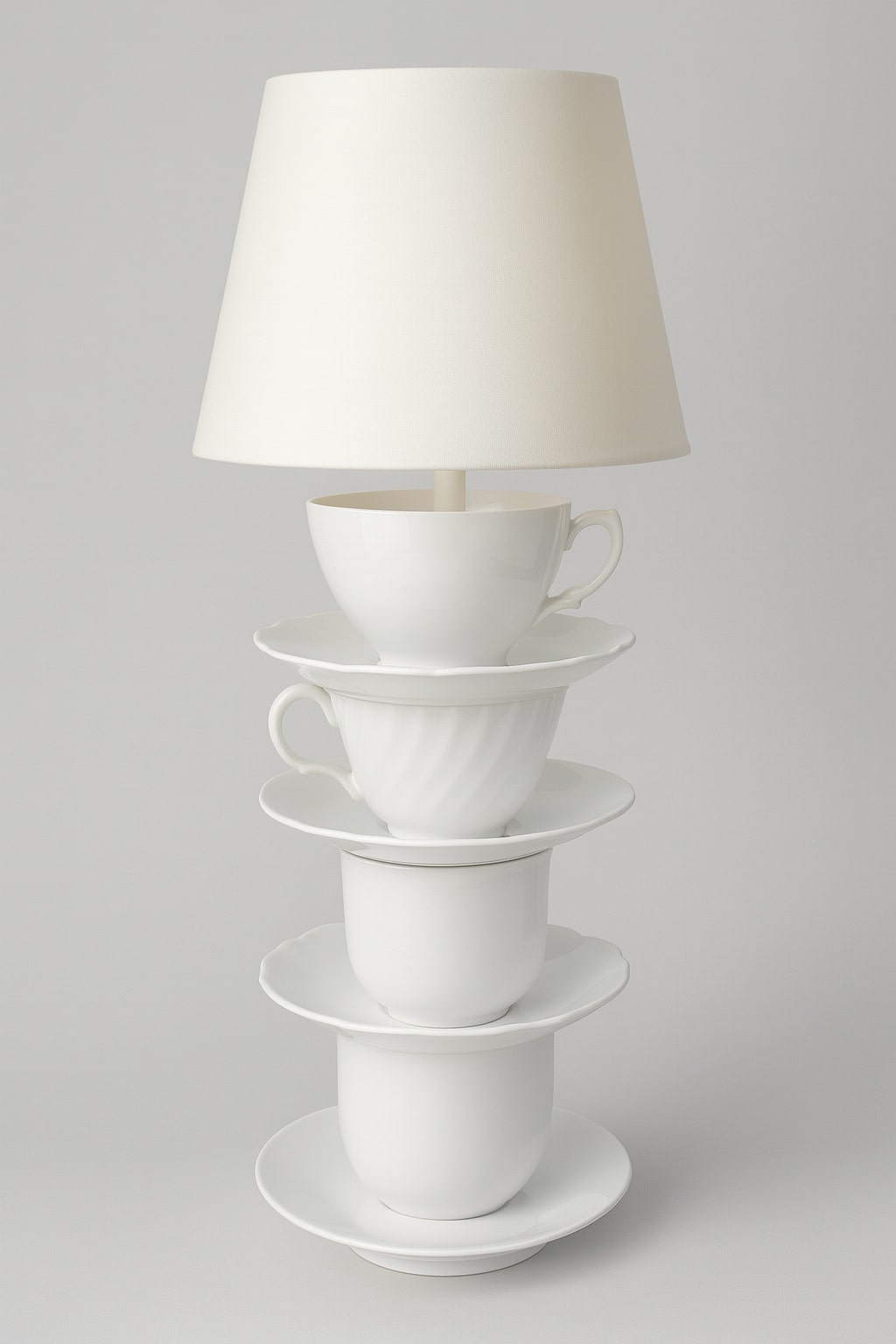
This teacup lamp project was my prototype. I have made a couple more since this one. It’s not particularly difficult, but some pieces can take more than three minutes to drill. To take care of my drill, I let it cool down a little between those pieces. If you have a corded drill, I would recommend it.
Here are a few more details about teacup lamps. Mandi from Vintage Revivals has a great project. I put mine together a little differently from Mandi.
gail
See more repurposed glassware projects here
i want to drill a very small hole in a china teacup (also glass ones) kind of behind the handle-to attach a crystal-imagine a velour ribbon tied on the handle and the crystal hanging sort of inside the cup-esp the ones that are decorated inside
what would I need?
Diane,
You would need a tiny diamond bit to put in your drill. The key is to keep it wet. You can have someone constantly spray water on it with a spray bottle, or set it in a small tub of water. I would suggest using a clamp of some sort–NOT holding the cup with your hand. You don’t want to add bling to your hand/fingers. I would also recommend trying your least favorite cup first. Good luck, be safe!
I love what you have done with teacups. I want to try this project. What kind of drill did you use, a Dremel?
HI Gail,
I love this tea cup lamp…my question..and it may seem silly but I have no clue…. i assume you are spraying the china…how are you avoiding drip or pooling spots on the china?
Yes, I used spray paint on my lamp.
many light coats is my favorite way to spray paint (out of a can)
shake well, be sure to hold the can far enough from your project.
Very nice looking drilling. I’ve just got my first drill and am a bit scared of it so excited to hear about different projects. To ask what might seem like a stupid question, isn’t there a risk of electrocuting yourself if you drill into a plate that’s submerged in water? Thanks.
Danielle,
I think this project may not be for novice drill users. 🙂 Only because it is difficult to get the drill to stay in one place, and keep a steady trigger hold. My drills are probably my favorite tools–right up there with my saws. I think once you get use to your drill, you will wonder how you ever lived without it.
As for electrocution, I would say it may be a possibility if your drill has a cord. All of my drills are battery operated. Whenever you use any plugged in device near water, you should use caution. I feel that drilling into water with a battery operated drill is perfectly safe.
thanks for stopping by and leaving a comment on this blog post about drilling china.
gail
Great tutorial, Gail! I always do it in the kitchen sink with the water slowly running over the bit. I never thought to use a plastic tub with water! Genius! Don’t you just love the diamond bits? I have several in different sizes. Love the lamp and especially the white!
This is really cute Gail! A great way to use up any odd pieces you have or can get at the Hosparus Thrift Shoppe for 50 cents a piece! I haven’t tried drilling china yet, but i might have to attempt it since you explained it so well!!!
Thank you for the brilliant tutorial and great tips!
How did you manage to drill the side hole on the bottom dish, is there a particular technique. I’m worried drilling at an angle might cause the dish to crack?
Yasmin x
Yasmin,
It’s really no different on the side. You just have to make sure that you keep it wet, or have it under water to keep it cool. 🙂
good luck, have fun!
gail
Hey really liked this diy. What type of paint do you use to paint your glassware? Thanks so much! 🙂
Hello. I love this idea but I have two questions.
1) How do you keep your spray paint from dripping? It seem that no matter how far I spray it drips grrr.
2) You didn’t really show HOW you put the lamp inner piece together.
Thanks a bunch
Tootles~
Sandy,
I use several very light coats when I spray paint. Try the new Colormaster version from Kyrlon! great nozzle. This post was mostly about drilling the glassware. Check out THIS post https://www.myrepurposedlife.com/2011/04/teapot-lamps.html to see how I put the lamp together. Thanks for stopping by and taking the time to leave a comment Sandy.
gail
At the very beginning of your tutorial you mention a bit that you used, but I don’t see a photo.
“This is the type of bit I used. Jamie bought it for me for Christmas at Home Depot. This is a variety pack, mine came with just the larger bit.”
I enjoyed the project. Thanks.
Another hint to making your lamps.You could use a 1/4″ all thread through the whole stack ; with your cord taped along side of the rod at intervals, and use 1/4″ fender washers (top & bottom ).
Drill another 1/4″ hole beside the original 1/4″ hole ( to make the overall hole elongated ). On the rod top and bottom; use 1/4-20 lock nuts with 3/8″ or 1/2″ neoprene washers between the fender washers and the glass.
Just snug the nuts and don’t over snug;due to breakage. When it starts getting a little harder in turning the nuts;STOP!!! I say all of this related to a 1/2″ hole; cause it looks like that is the size you are using.
Note: Be sure to allow enough all thread at top for mounting harp and socket .
PS: You can also use cheap clear silicone at the points of where U were using the epoxy. Mount all of this together; including all thread, nuts, and both washers. This way U don’t have to wait for any thing to set up.
Apply silicone as U go. The rod. nuts and washers will hold all together as U are finishing up the project.
Silicone dries up in a couple of hours and cures in 8 hours.
The rod makes it more rigid as well as it keeps it together.
I have been making 2 tiers single tea cup Bird Feeders.
The 2 tiers have a saucer inverted at top for a dome or roof ( how ever U want to call it ). I also make tea cup feeders with saucer position at bottom of cup ( with eye bolts 3″ or 4″) to accommodate the size.
I also opened a new line of 2 Tiers and 3 Tiers servers as well as candy dishes.
Thank you for your detailed suggestions! 🙂 I rarely buy new parts. I’m a use what you got (repurpose and upcycle) kind of girl. If a curbed or thrifted lamp has allthread, that’s what I would use. 🙂
I only made a few of these lamps.
Thanks so much! It sounds like you make cute stuff!
gail
What type of paint did you use to cover china/glass? Did you prime first?
This is just beautiful! Thank you for sharing your technique!